
White-faced Saki

Feeding mostly on fruits and sometimes nuts, seeds and insects, the White-faced Saki (Pithecia pithecia), is a species of saki monkey found in the savannas and marsh forests in the countries of Brazil, French Guiana, Guyana, Suriname and Venezuela. These tree-living primates are fast moving and shy and usually make bird-chirping sounds and display aggression by body-shaking, arched posture and loud growl. The species display obvious sexual dimorphism with females having shorter hair than males. Males have blacker pelage, with reddish-white forehead, face and throat and females with brownish-grey fur and white or pale brown stripes around the corners of the nose and mouth.
CottontopTamarin
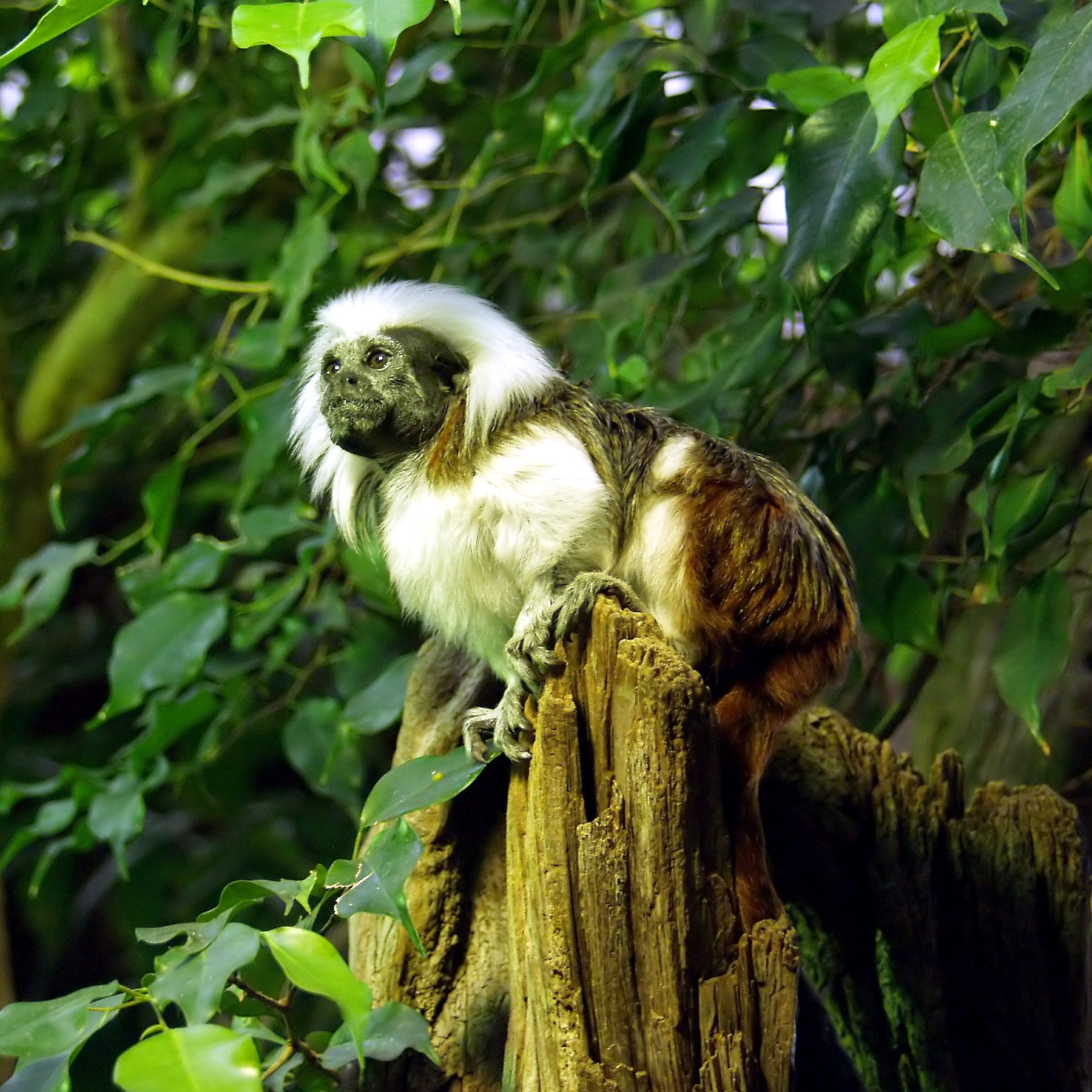
Also known as Pinché Tamarins, Cottontop Tamarins (Saguinus oedipus) are among the smallest of the primates weighing less than a pound (0.5 kg), with a head to body length of 7 to 12 inches, and a 12-17 inches tail. It is found today in the tropical forest edges and secondary forests of Colombia where it is arboreal and diurnal.
Cottontops have a repertoire of 38 vocalizations including birdlike whistles, soft chirping sounds, high-pitched trilling, and staccato calls which researchers find unusually sophisticated as it conform to grammatical rules, expressions of curiosity, fear, dismay, playfulness, warning, joy, and calls to their young.
Cottontop Tamarins are one of the most endangered primates in the world with an estimated population of 6000 in the wild of which 2000 are adults.
Proboscis Monkey

The Proboscis Monkey (Nasalis larvatus) is one primate one will easily recognize and not easily forget. It takes its name from the male’s long gigantic nose, its most distinctive trait. Also known as the Monyet Belanda in Malay, the Bekantan in Indonesian or simply the Long-nosed Monkey, it is endemic to the mangrove forests and swamps in the south-east Asian island of Borneo.
Adult Proboscis Monkeys are mainly reddish-brown, with grayish limbs; males have a large fleshy nose which overhangs its mouth; the female’s nose is not as large as the males.
Only about 1000 of these monkeys are known to exist in the wild as a result of habitat loss and hunting.
Silky Sifaka

The Silky Sifaka (Propithecus candidus) is a species of lemur found only within a few protected areas in the rainforests of northeastern Madagascar. It is one of the rarest mammals on earth, and is listed as one of the world’s top 25 most critically endangered primates with an estimated global population of 100-1000 individuals left. An adult can weight 5-6.5 kg, with a head-body length of 48-54 cm, and a tail length of 45-51 cm. The species get its common English name from its long, silky and white hair covering. They have bare muzzle and face, the skin a mix of pink and black, with some members having all pink or all black faces.
Tarsier

Tarsiers are small primates with big eyes; each eyeball is approximately 16 mm in diameter, the same size as their entire brain. They have very long hind limbs and they get their names from their extremely elongated tarsus bones. Their fingers are also elongated, with the third finger about the same length as the upper arm, and their tail 20 to 25 cm long. Tarsiers have very soft, velvety pelage, which is generally buff, beige, or ochre in color. They are the only carnivorous primates being primarily insectivorous and are known to also prey on small vertebrates including birds, snakes, lizards and bats. Their population today is restricted in several Southeast Asian islands including the Philippines, Sulawesi, Borneo, and Sumatra.
Aye-aye

The Aye-aye (Daubentonia madagascariensis) is another lemur found only in Madagascar. This strange-looking, unusual primate uses its rodent-like teeth to gnaw holes in the wood then inserts its long, thin middle finger to pull grubs out. They weigh about 2-3 kg (4.4-6.6 lb) with a head-body length of 30-37 cm (12-15 in), and a tail 44-53 cm (17-21 in) long.
These nocturnal primates are killed by some natives due to an ancient Malagasy legend which believed that they bring death to the village it appears in. On the other hand, some minority areas view them as a good omen.
Source: scienceray.com, scienceray.com, flickr.com, akshatb.wordpress.com, commons.wikimedia.org
Comments
Post a Comment
Berikan komentar Anda, dengan bantuan Anda kami tetap ada